
MICROGRID BI-DIRECTIONAL DC-DC CONVERTER MATLAB SIMULINK SIMULATION
Bi-directional DC-DC converters play a critical role in modern microgrids by enabling controlled power transfer between the DC bus and energy storage units such as batteries and supercapacitors. This project presents a MATLAB Simulink simulation of a microgrid bi-directional DC-DC converter for efficient charging, discharging, voltage regulation, and energy management.
The model demonstrates converter operation under different loading and source conditions, showing how the converter supports stable DC bus performance while managing bidirectional energy flow. This project is useful for research in DC microgrids, battery energy storage systems, renewable integration, and smart power electronic control.
Key Features
- Bi-directional DC-DC converter modeling in MATLAB Simulink
- Battery charging and discharging operation
- DC bus voltage regulation and power flow control
- Microgrid energy storage integration
- Performance analysis under varying load conditions
Methodology
The proposed system is implemented in MATLAB Simulink using a bi-directional converter topology integrated with a DC microgrid and battery storage unit. The converter is controlled to operate in both buck and boost modes, depending on battery charging or discharging requirements, while maintaining regulated DC bus voltage and stable power exchange.
- DC microgrid and battery modeling
- Bi-directional converter buck and boost mode operation
- PWM-based switching control strategy
- DC bus voltage and bidirectional current regulation
Applications
- DC Microgrids
- Battery Energy Storage Systems (BESS)
- Renewable Energy Integration
- Electric Vehicle Energy Interfaces
- Smart Grid Energy Management
MATLAB Simulink DC Microgrid Project
This MATLAB Simulink project demonstrates the operation of a microgrid bi-directional DC-DC converter for energy storage control and DC power regulation. The simulation model can be used for research in microgrid power electronics, distributed energy systems, and advanced converter control strategies.
Keywords: MATLAB projects, Simulink projects, bi-directional DC-DC converter, microgrid converter, DC microgrid simulation, battery charging discharging, power electronics MATLAB, DC bus regulation.
Download Microgrid Bi-Directional DC-DC Converter MATLAB Simulink Project
About Matlab Projects CODE
Matlab Projects CODE (www.matlabprojectscode.com) is a dedicated research support platform helping engineering students, postgraduate scholars, and Ph.D. researchers with high-quality technical guidance and project development. We provide expert assistance in MATLAB and Simulink based simulations, research project implementation, thesis development, journal paper support, and academic assignment solutions across various engineering domains.
Our goal is to support students and researchers worldwide in completing their academic projects, dissertations, and research work with innovative simulation models and practical engineering solutions.
What We Do
- Ph.D. Research Support and Technical Guidance
- Thesis and Dissertation Development Assistance
- Journal Paper Writing and Publication Support
- MATLAB and Simulink Project Development
- Engineering Assignments and Coursework Assistance
- Final Year Projects for B.E, B.Tech, M.E, and M.Tech Students
- Research Simulation Models and Algorithm Implementation
- Technical Documentation and Research Reports
Experts In
- MATLAB & Simulink Modeling and Simulation
- Power Electronics and Power Systems
- Renewable Energy Systems and Microgrids
- Electric Vehicles and Motor Drive Control
- Battery Management Systems and Energy Storage
- Control Systems and Intelligent Controllers
- Artificial Intelligence and Deep Learning Applications
- Autonomous Vehicle Systems and Automotive Control
- RF, Microwave and Antenna Design (HFSS, CST, COMSOL)
- Signal Processing and Communication Systems
Who We Support
We provide research and technical support for engineering students, master's scholars, Ph.D. researchers, and university academics worldwide. Our services help students complete their projects, thesis, dissertations, research papers, and technical assignments successfully with advanced simulation models and professional documentation.
Contact
Website: www.matlabprojectscode.com
Email: info@matlabprojectscode.com
WhatsApp: +91 83000 15425
OUTPUT - MICROGRID BI-DIRECTIONAL DC-DC CONVERTER MATLAB SIMULINK SIMULATION
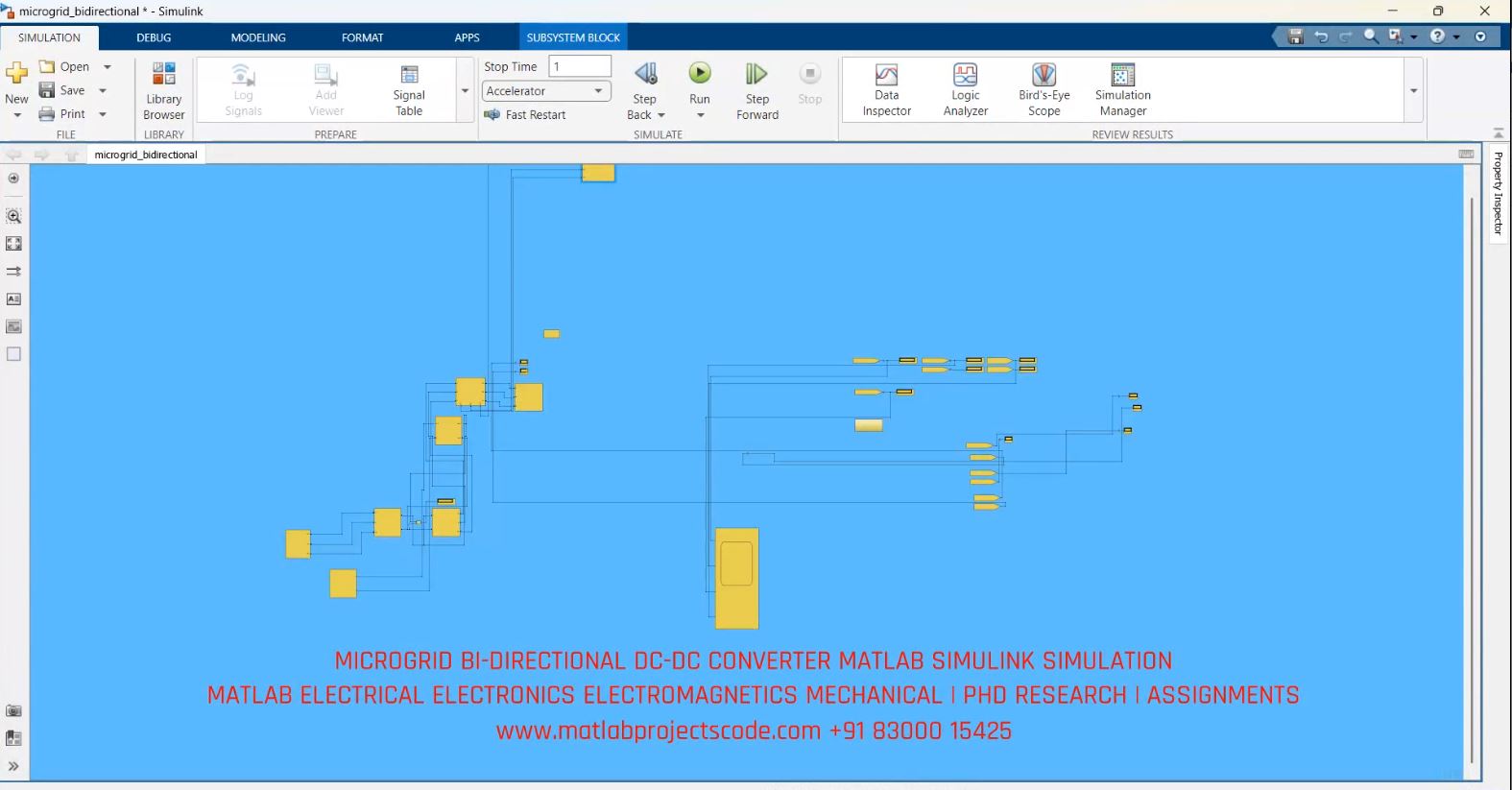
This project is suitable for PhD research, master's thesis, and final year engineering projects related to DC microgrids, battery energy storage systems, renewable energy integration, converter control, and smart power electronic energy management in MATLAB Simulink.
Related MATLAB Projects
- DC Microgrid MATLAB Simulink
- Battery Energy Storage System MATLAB
- Bi-Directional Converter Control MATLAB
- Renewable Energy Microgrid Projects
MATLAB Code and Simulation Files
This project includes complete MATLAB source code, Simulink models, converter control implementation files, and detailed documentation to help researchers understand microgrid bi-directional DC-DC converter operation.
Frequently Asked Questions
What is a bi-directional DC-DC converter in a microgrid?
A bi-directional DC-DC converter allows power to flow in both directions between a battery energy storage system and the DC bus, enabling both charging and discharging operation in a microgrid.
Which software is used for this simulation?
This project is implemented using MATLAB Simulink for DC microgrid modeling, converter design, and control strategy simulation.
What are the applications of this project?
This project is useful in DC microgrids, battery storage integration, electric vehicles, renewable energy systems, and smart grid power electronics research.
MATLAB Projects for PhD Research
Matlab Projects CODE provides advanced MATLAB and Simulink based research projects for PhD scholars, postgraduate students, and engineering researchers working in power electronics, renewable energy systems, electric vehicles, battery management systems, control systems, autonomous vehicles, and artificial intelligence applications.